

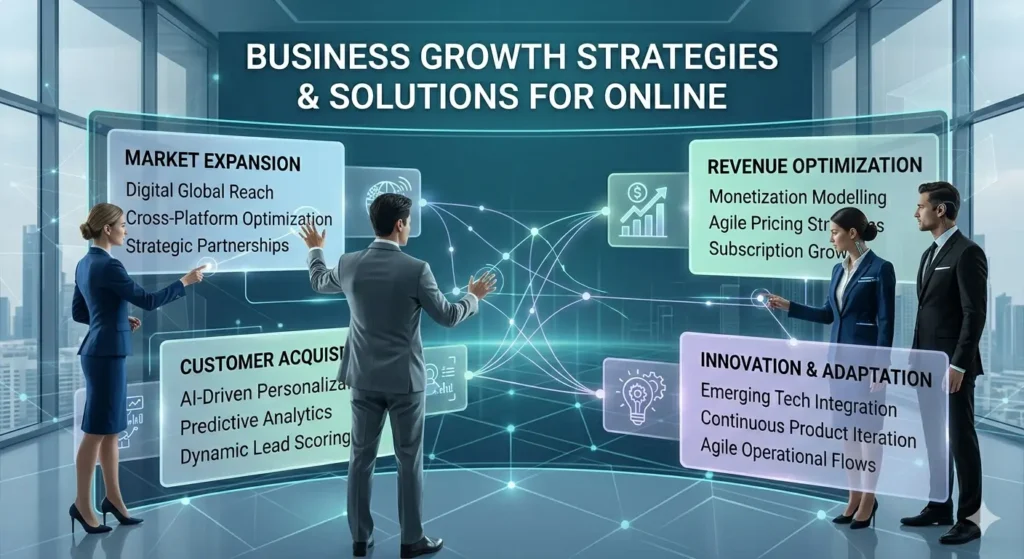
Digital Scalability: Strategic Frameworks and Solutions for Sustained Online Business Growth
In the hyper-connected commerce landscape, establishing an online presence is no longer the final milestone—it is merely the baseline. For online business growth The real challenge lies in sustainable scalability. As customer acquisition costs escalate and digital markets become heavily saturated, growing an online business demands a sophisticated synthesis of data-driven insights, frictionless technological infrastructure, and customer-centric retention models.
To transition from stagnation to predictable expansion, digital enterprises must move beyond superficial marketing tactics and adopt core structural strategies. Below is a comprehensive blueprint detailing the critical pillars and solutions required to drive sustained online business growth.
1. The Architecture of Hyper-Personalization
For years, personalization in online business was limited to inserting a customer’s first name into an email subject line. Today, that approach is fundamentally insufficient. Modern hyper-personalization relies on leveraging behavioral data, predictive analytics, and real-time interaction tracking to deliver highly tailored experiences across every digital touchpoint for online business growth
To scale effectively, online businesses must move beyond basic demographic clustering. By integrating a Customer Data Platform (CDP) with your e-commerce engine, you can map out granular user personas based on actual browsing history, purchase frequency, average order value (AOV), and contextual engagement metrics. Predictive algorithms can then forecast what a customer is likely to purchase next, allowing your platform to dynamically alter its homepage layout, recommend complementary items, and deploy personalized pricing structures or promotional incentives at the exact moment of high purchase intent.
This deep level of individualization directly mitigates choice fatigue, building a seamless path from product discovery to final checkout. Transitioning from generic marketing to hyper-personalized workflows typically yields a 15% to 20% increase in conversion rates and drastically lowers cart abandonment by providing immediate relevance to the buyer.
Building a Unified Omni-Channel Ecosystem For Online Business Growth
The modern consumer journey is highly fragmented and non-linear. A buyer might discover a brand via an Instagram Reel, research reviews on a desktop browser during their lunch break, compare pricing via a mobile application, and ultimately complete the purchase through an automated SMS link or social commerce checkout. Businesses that operate these channels in silos face structural inefficiencies and high drop-off rates for online business growth
True omni-channel growth involves aligning marketing, inventory, log-in states, and customer service into a single, cohesive ecosystem. If a user adds an item to their cart on a mobile app, that exact cart should be visible when they log in via desktop. Furthermore, cross-channel attribution modeling is critical. Instead of crediting the final click exclusively, multi-touch attribution gives data engineering and marketing teams a granular understanding of how organic content, paid ads, and email nurturing work in tandem to drive conversions. This comprehensive visibility prevents misallocating ad spend and maximizes the overall return on investment (ROI).
Aggressive Conversion Rate Optimization (CRO) For Online Business Growth
Many digital entrepreneurs mistakenly believe that the primary solution to stagnant revenue is throwing more money at top-of-funnel customer acquisition. However, pouring paid traffic into a leaky conversion funnel is incredibly cost-ineffective. Prioritizing Conversion Rate Optimization (CRO) allows businesses to extract significantly more value from their existing web traffic.
CRO is an ongoing iterative science driven by continuous A/B testing and user experience (UX) analysis. Key areas for structural modification include:
- Frictionless Checkout Architecture: Implement single-page checkouts, integrate express digital wallets (such as Apple Pay, Google Pay, or Shop Pay), and offer guest checkout options to drastically minimize cognitive friction.
- Core Web Vitals & Site Speed: Every millisecond of delay dramatically degrades conversion rates. Compressing visual media, leveraging content delivery networks (CDNs), and eliminating render-blocking scripts are technical prerequisites for scale.
- Heuristics and Dynamic Trust Elements: Displaying real-time social proof, contextual security badges, clear return policies, and transparent micro-copy regarding shipping fees directly addresses psychological barriers to purchase.
Shifting from Acquisition to Lifetime Value (LTV)
The underlying financial health of an online business is dictated by the ratio between Customer Acquisition Cost (CAC) and Customer Lifetime Value (LTV). In an environment where ad networks frequently alter algorithms and push advertising costs higher, relying purely on first-time buyers is a precarious business model. Long-term profitability is unlocked post-purchase.
To maximize LTV, brands must build programmatic retention systems. Tiered loyalty frameworks, value-added post-purchase education, and automated transactional workflows keep your brand top-of-mind without incurring recurring ad costs. For applicable businesses, transitioning parts of the product catalog to a subscription model introduces highly predictable, recurring revenue streams. When a business successfully increases its repeat customer rate by even 5%, overall profitability can surge exponentially because returning customers bought into the brand value proposition, spend more per transaction, and act as organic brand advocates.
Modern Technical Infrastructure: Headless Commerce
Legacy monolithic architectures frequently limit structural business growth. As organizations scale, standard out-of-the-box platforms often suffer from slow loading times, inflexible design restrictions, and poor backend scalability. Decoupling the front-end presentation layer from the back-end commerce engine—a framework known as headless commerce—provides the agility required for rapid expansion.
By utilizing APIs to pass data instantly between backend databases and frontend interfaces, businesses can deliver lightning-fast web experiences and deploy rapid design changes without breaking core operational logic. This architectural flexibility enables seamless expansion into international markets with multi-currency support, multi-warehouse localized fulfillment, and rapid deployment across entirely new digital mediums, preparing the enterprise for future waves of technological disruption.
Conclusion: The Compounding Principle of Scale
Online business growth is rarely the result of a single, isolated breakthrough. Instead, it is achieved through the compounding effect of continuous micro-optimizations across data utilization, channel alignment, technical efficiency, and customer experience. By executing these strategic frameworks and investing in robust infrastructure, digital enterprises can break free from erratic revenue cycles and unlock repeatable, predictable, and highly profitable scalability.